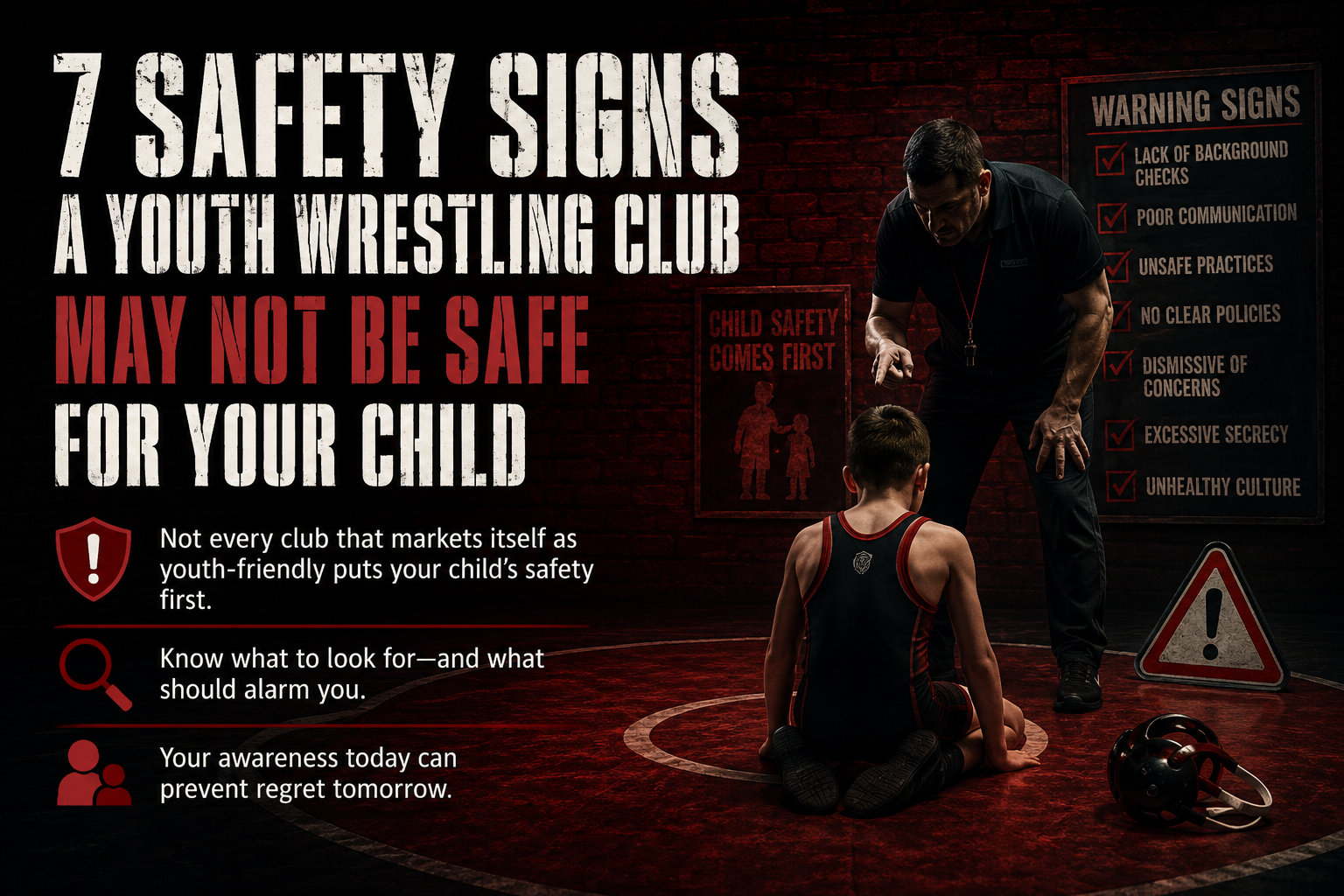
Enrolling your child in wrestling can build discipline, resilience, and athletic confidence. But not every club that markets itself as youth-friendly actually operates with child safety as a priority. Before you commit to a program, you need to know what to look for — and more importantly, what should alarm you.
As explored in our flagship guide, The Hidden Safety Risks in Youth Wrestling Clubs Most Parents Never See, many of the most serious risks are invisible at first glance. This article goes deeper by giving you seven concrete warning signs to evaluate any wrestling program before your child steps onto the mat.
Each warning sign below is grounded in patterns that child safety researchers and youth athletics advocates consistently observe. If you notice even two or three of these in a program you’re evaluating, that warrants serious pause.
Warning Sign 1: Coaches Resist or Discourage Parent Observation
Healthy sports programs operate transparently. If a coach or club director tells you that parents are not allowed to watch practices or makes you feel unwelcome when you try that is a structural red flag. While occasional closed sessions for skills testing can be normal, a blanket policy of excluding parents from the training environment removes a critical layer of accountability.
In future content exploring this dimension further, we’ll be looking at whether parents can legally observe youth wrestling practices and what rights clubs can and cannot restrict, a topic many families don’t realize has specific legal and policy implications.
What to do: Ask directly about the observation policy before enrolling. A confident, safety-conscious program will welcome your presence.
Warning Sign 2: No Visible or Accessible Safeguarding Policy
Every legitimate youth sports organization should have a written safeguarding or child protection policy. This document should outline how the club handles misconduct allegations, what background checks are required for coaches, and how children can report concerns. If a club cannot produce this document within 48 hours of a request or acts confused by the question, that is deeply problematic.
Our published guide on How to Choose the Right Youth Sports Program for Your Child covers safeguarding policy as one of the top three vetting factors parents should apply before enrolling.
Warning Sign 3: Vague or Unverifiable Coaching Credentials
In youth wrestling, coaching credentials vary widely by state and organization. Some programs employ coaches who claim national-level certifications they never earned or whose qualifications expired years ago. When you ask to see a coach’s credentials and are met with deflection, generalities, or the response ‘trust me,’ that is a warning sign.
You can use our Coach Credential Verification Service to independently confirm whether the credentials presented by any youth sports coach are current, authentic, and appropriate for the age group they’re working with.
Warning Sign 4: High Athlete Turnover With No Explanation
If you speak to other parents and discover that a significant number of children have left the program over the past year, ask why. High dropout rates in youth sports programs are not always about normal attrition — they can signal a toxic training culture, emotionally unsafe coaching, or unresolved safety incidents that prompted families to leave quietly rather than publicly.
Pay attention to the language families use when discussing why they left. Phrases like ‘it wasn’t the right fit’ or ‘my child lost interest’ may mask more serious concerns they didn’t feel safe raising.
Warning Sign 5: Overtraining With No Recovery Protocol
Youth wrestling programs that run daily two-a-day practices, schedule tournaments every weekend, and offer no structured rest periods are not building athletes as they are burning them out. Overtraining in young wrestlers increases injury risk significantly and, when combined with pressure from coaches to ‘push through pain,’ creates an environment where a child may sustain serious harm.
For context on how overtraining affects young bodies and minds, see our article on The Overtraining Crisis: How Youth Sports Programs Push Children Too Hard.
Warning Sign 6: Adult-Athlete Contact Happens Without Supervision
Any legitimate youth sports organization should follow a two-adult rule or equivalent safeguarding protocol for situations involving a coach and a minor athlete. If a coach regularly meets with your child one-on-one in a closed space — whether in the gym, in an office, or via private messaging apps — that is a serious boundary violation regardless of whether anything inappropriate has occurred.
Our Youth Sports Safety Consultation helps parents understand exactly what structural safeguards a legitimate program should have in place and how to assess whether a club they’re considering actually implements them.
Warning Sign 7: Dismissive Response to Complaints
Perhaps the most revealing test of a wrestling club’s safety culture is how leadership responds when someone raises a concern. If a parent or athlete reports a coach’s behavior and is told ‘that’s just how wrestling is,’ ‘you’re being overprotective,’ or worse is discouraged from continuing to speak up that organization is protecting itself at the expense of its athletes.
Related Article: Understanding SafeSport Policies: A Parent’s Guide
Safe programs take every concern seriously, document it, and follow a clear process. Programs that dismiss concerns are programs where unsafe conditions can escalate without accountability.
What to Do If You Notice These Signs
If one or more of these warning signs resonates with what you have observed, do not dismiss your instincts. Document what you’ve seen, speak with other families, and if necessary, escalate your concerns to the governing body for youth wrestling in your state.
You do not owe any sports organization your silence in exchange for access to their program. Your child’s safety is not negotiable.
Frequently Asked Questions
Are these warning signs specific to wrestling, or do they apply to all youth sports?
While this article focuses on wrestling clubs, the majority of these warning signs apply across all contact youth sports. Wrestling does carry some unique risks given its physical nature and weight-class culture, which makes safeguarding policies even more critical.
What if a program has great reviews online but shows some of these signs in person?
Online reputation is not a reliable safety indicator. A club can have excellent Google ratings while maintaining problematic internal practices. In-person observation and direct policy review are far more reliable evaluation methods.
Should I confront a coach directly if I see warning signs?
Raising concerns with a coach directly is reasonable if the issue is minor and communication-based. For structural safety failures or boundary violations, concerns should be directed to program leadership, and in serious cases, to external authorities.
How many warning signs are ‘too many’ before I should pull my child?
There is no universal threshold, but even a single serious sign, especially around boundary violations or dismissal of safety concerns and warrants immediate action. Multiple minor signs together should be taken just as seriously.